

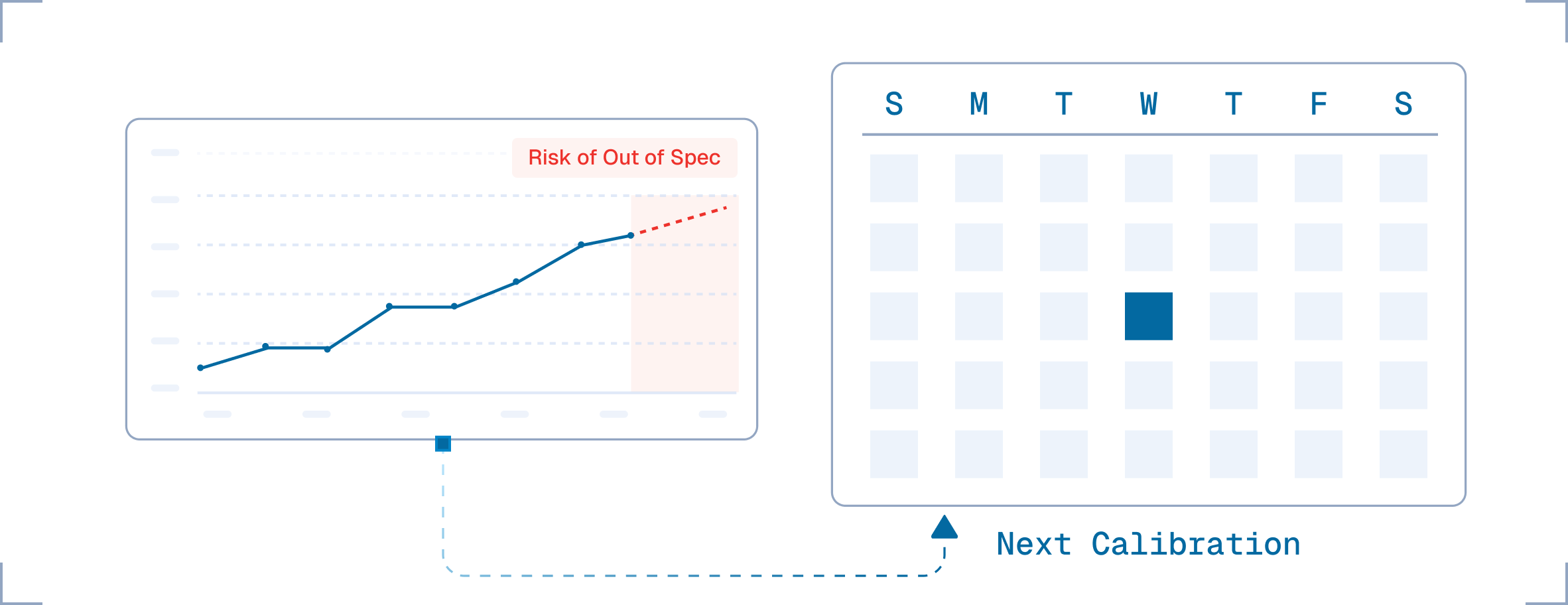
Most labs calibrate on a fixed schedule: every 6 months, every 12 months, because that's what the manufacturer recommended or what the lab decided years ago. Some instruments are calibrated far more often than they need. Others drift out of tolerance between calibrations, and nobody knows until the as-found result comes back.
Both cost money. Only one costs you results.
ISO/IEC 17025 clause 6.4 requires a calibration program that is reviewed and adjusted as needed. The joint ILAC-G24 / OIML D 10 guidance describes methods for reviewing recalibration intervals based on evidence, such as as-found results and observed drift, rather than habit.
Materials testing: load cells and extensometers on high-use machines get tighter intervals, while low-use hardness blocks with consistently good as-found results can be extended with documented justification.
Biopharma QC: balances and pipettes with frequent intermediate checks can be managed by trend, while HPLC detectors with a drift history get earlier attention before release testing.
Yes, if the decision is based on evidence, documented and reviewed. Accreditation bodies expect a rationale, not a guess.
Evaluate the impact on results produced since the last good calibration, decide on any recall or customer notification, and treat it as nonconforming work under clause 7.10.
Trucision was built around these criteria. Explore Lab Agent OS or book a 30-minute call.

AI driven lap operations for regulated industries.Predictive diagnostics, service monetization, and compliance-grade telemetry for instrument OEMs.
BUILT FOR SECURE OEM DEPLOYMENT