

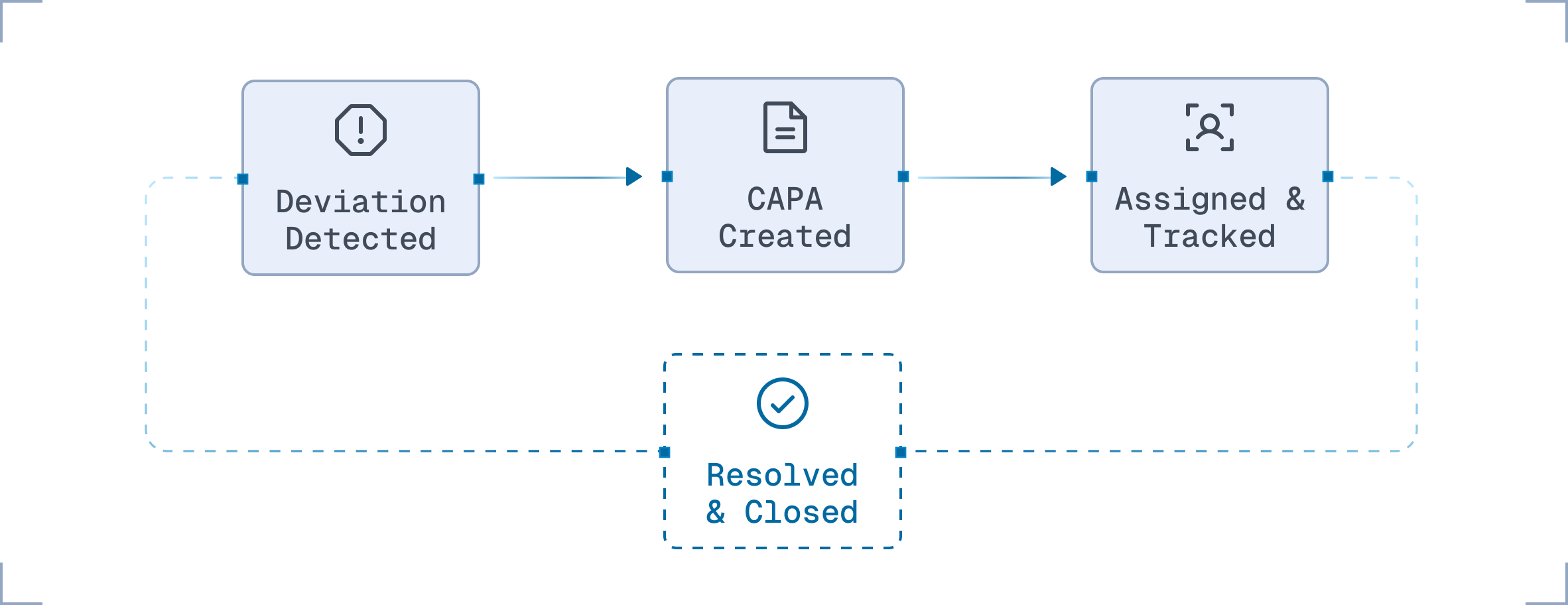
An out-of-specification result starts a clock. In biopharma QC, it can hold up a batch release. In a materials testing lab, it can delay a customer certificate or trigger a costly retest. Either way, the investigation needs to be fast, thorough and defensible, and that's hard when the evidence is scattered across five systems.
For GMP labs, FDA's guidance on investigating OOS test results describes a phased approach: a laboratory investigation first, then a full-scale investigation if no lab error is found. It also warns against "testing into compliance" by retesting until a passing result appears. For ISO/IEC 17025 labs, clauses 7.7 (ensuring validity of results) and 7.10 (nonconforming work) set the expectations.
Biopharma QC: an assay result fails. The investigator immediately sees the HPLC's recent pressure trend, system suitability, reference standard lot and the analyst's training, and can rule lab error in or out quickly.
Materials testing: a tensile result falls below spec. Grip condition, extensometer calibration, specimen preparation records and similar past failures are pulled together for review.
Out-of-specification means a result is outside its acceptance limits. Out-of-trend means a result is within limits but unexpected given previous data, often an early warning.
Retesting repeatedly until a passing result is obtained, without a justified reason to invalidate the original. Regulators treat it as a serious data integrity issue.
Need a starting point? Download our free deviation report template, or see how Trucision supports investigations.

AI driven lap operations for regulated industries.Predictive diagnostics, service monetization, and compliance-grade telemetry for instrument OEMs.
BUILT FOR SECURE OEM DEPLOYMENT