

By Trucision staff
Key takeaways: Putting your lab's files in SharePoint and asking Copilot about them is a good start for finding documents. It isn't a way to run lab operations. A chatbot answers from whatever text it finds. A lab needs the AI to work inside a structure that hands it live data, checks every step against your rules, only reads from your systems, proves each statement with a record, and keeps an audit trail. That structure is called a harness, and it matters more than which AI model sits in the middle.
Most lab managers have been through some version of this in the last two years. IT turns on Copilot. Someone moves the SOPs, calibration certificates and old deviation reports into a SharePoint site. The idea is simple: the AI can read everything now, so ask it anything.
For a while, it feels like progress. It finds documents faster than the shared drive ever did, and it writes a decent first draft of an email. Then someone asks a real operations question, like "was balance 3 in calibration when we ran those samples last Tuesday?", and the answer comes back confident, well written and wrong. Or right, but with no way to prove it.
That isn't a flaw in Copilot. It's a mismatch between what a chatbot is built to do and what a lab needs.
A chatbot does three things: it takes your question, finds text that looks related, and writes a fluent answer. That's useful for a lot of work. But look at what it's missing for a lab:
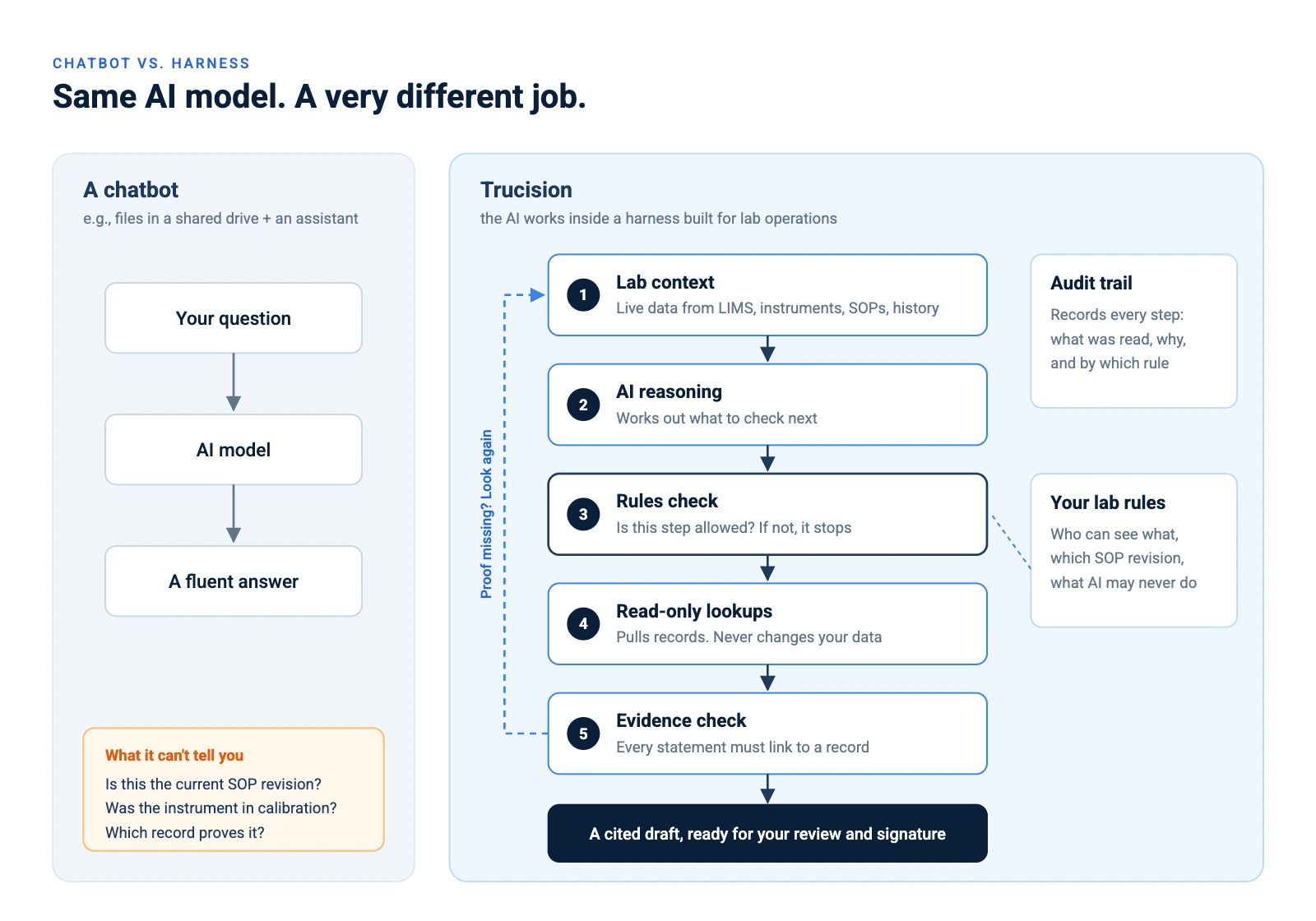
In AI engineering, a harness is everything built around the model that decides what it sees, what it is allowed to do, and what has to be true before its output is accepted. The model is the engine. The harness is the rest of the vehicle: steering, brakes, dashboard and a log of every trip.
Here is the difference in one picture.
In plain terms, here's what each step does in a lab:
The result isn't a chat reply. It's a draft (a deviation write-up, an investigation summary, an answer to "what changed on this instrument?") with every claim linked to its record, ready for a qualified person to review and sign. Every step along the way is logged.
Take an everyday question: "Can we release the results from HPLC 2 last Thursday?"
| What the lab needs to know | Chatbot over SharePoint | AI inside a lab harness |
|---|---|---|
| Was the instrument in calibration that day? | Finds a calibration certificate; can't tell if a newer one exists or if it lapsed | Checks calibration status as of Thursday and links the record |
| Did system suitability pass? | Not in SharePoint, so it can't say, or it guesses | Reads the run log and links the result |
| Which SOP revision applies? | Quotes whichever revision it found first | Uses the revision effective on Thursday |
| Any open deviations on this instrument? | Only if someone saved them to the site | Checks the quality system and lists them |
| Who makes the call? | Implies an answer | Prepares the evidence; release stays with QA |
This is an illustrative example.
We hear versions of the same story often. The comments below are illustrative, written to reflect that common pattern. They are not quotes from real people.
"We spent a quarter moving everything into SharePoint so Copilot could find it. It finds it. It just can't tell me which version was live when the sample ran."
"It gave me a great summary of a deviation. Then QA asked where each line came from and I couldn't answer."
"The documents were never the hard part. The hard part is lining up the LIMS, the instrument and the calibration record for one Tuesday afternoon."
"I don't need a smarter search box. I need something that does the legwork and knows when to stop and hand it back to me."
None of this means turning Copilot off. It's good at writing, summarizing and finding documents, and your staff already know it. The point is that lab operations need more than a document search.
Trucision is that layer. It connects to the systems you already run (LIMS, instrument software, calibration and quality systems), reads from them without changing them, and runs every AI task inside the harness described above. Copilot and other assistants can call Trucision as a tool through standards such as MCP (Model Context Protocol), so a question asked in Copilot gets a lab answer with records behind it.
Enrisk, the company behind Trucision, is a Microsoft partner. If your organization buys software through Microsoft, you can find Trucision on Microsoft Marketplace.
If the answer to the first four is "no" or "not really," you have a helpful chatbot. That's fine for drafting emails. It isn't ready to sit inside your quality system.
The structure around an AI model that controls what data it receives, what it is allowed to do, how its output is checked, and what gets logged. In a lab, the harness is what turns a general AI model into something you can defend to an auditor.
It works well for finding and summarizing documents. Lab operations questions depend on live data across several systems, the SOP revision in effect on a specific date, and proof for each conclusion. A chatbot over a file library doesn't provide those on its own.
No. Trucision reads from the LIMS, instrument software and quality systems you already use. Your systems of record stay where they are.
Yes. Copilot can call Trucision as a tool, so staff keep the assistant they know while lab answers come from a system built for lab work.
A printable checklist to test any AI tool your lab is considering, including a Copilot and SharePoint setup, against the five steps of a lab harness, with what a good and a weak answer look like. Send me the checklist.
Bring one real question from last week and we'll show you how a harness would answer it, with the records behind it. Book a 30-minute call.
Examples and comments in this article are illustrative.

AI driven lap operations for regulated industries.Predictive diagnostics, service monetization, and compliance-grade telemetry for instrument OEMs.
BUILT FOR SECURE OEM DEPLOYMENT