

By Trucision staff
Key takeaways: A mid-sized testing lab generates tens of thousands of instrument readings, results and quality records every day. No team can link and check all of it by hand, so the costliest problems stay quiet until a complaint or audit finding. General assistants like ChatGPT and Microsoft Copilot help with writing and search, but on their own they don't know your instruments, methods or effective SOP revisions, and they aren't validated for regulated records. Labs need an agentic layer that understands lab operations end to end and can plug into the assistants staff already use.
If you manage a testing lab, you already know how the day goes. You come in, check the QC from overnight, find two instruments with results you don't love, and start pulling threads. Was the balance calibrated? Did the standard lot change? Who was on shift? Is this the same pH meter that acted up last month? By the time you've answered those for one instrument, someone needs you to sign a CoA, a customer wants a rush result, and an analyst has called in sick.
Meanwhile, everything you didn't get to keeps running.
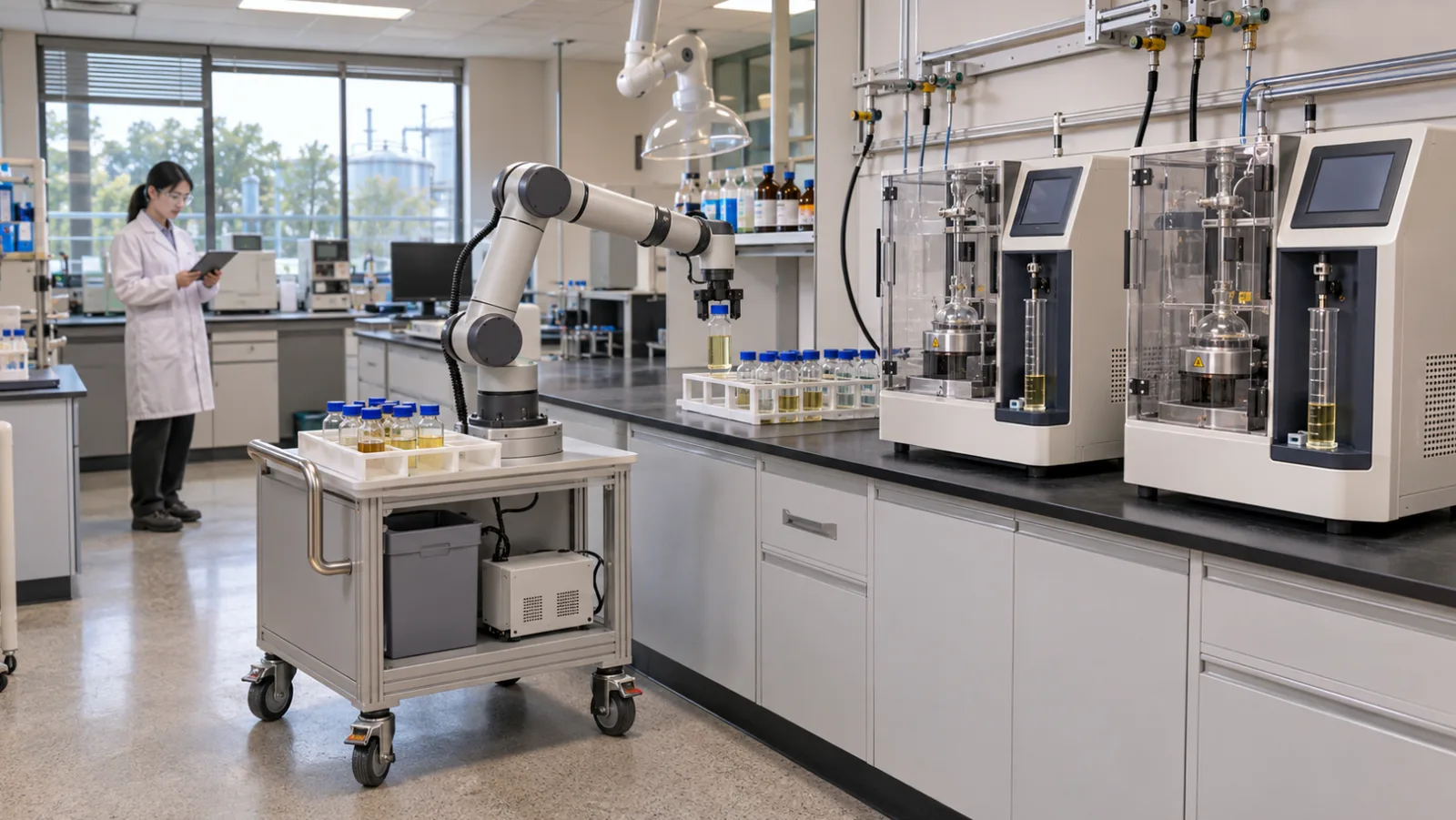
Take an example lab: 40 instruments, two shifts, one site. If each instrument reports its status every two minutes, that's 720 readings per instrument per day, or 28,800 readings across the lab, before anyone runs a sample. Add a few hundred test results, a few dozen QC checks, calibration records, supplier CoAs, open deviations, CAPAs with due dates, and the SOP that was revised last Tuesday. Each of those is a place where something can quietly go wrong.
Nobody reads all of that, and nobody expects you to. In practice, labs run on three things: alarms, spot checks, and the experience of a few senior people who "just know" when an instrument is off. That works until it doesn't.
The failures that hurt are rarely the loud ones. A broken heater throws an alarm and gets fixed the same day. The expensive problems are slow and quiet: a condenser that loses a little efficiency every week, a pressure sensor drifting a fraction of a unit, a method that passes QC but produces slightly different results on nights than on days.
Here's an example. A distillation analyzer starts stopping short of its normal end point on some runs. Each run still produces a result, and nothing trips an alarm. Its sister units on the same product don't show the pattern. The evidence is in the data the whole time, but it only shows up if someone compares that unit against its peers, every day. Usually nobody does.
Most lab managers have a version of this story. It usually comes out during a customer complaint, an audit finding, or an investigation where someone finally pulls six months of data and asks, "How long has this been going on?"
When something does get flagged, the work is mostly gathering evidence. Which runs did this instrument produce since the problem started? Which lots or customer samples were affected? What does the SOP say about this limit? Was the instrument in calibration? Was the analyst trained on the current revision?
None of that is hard. It's just slow. The evidence lives in the LIMS, the instrument software, the calibration system, the document system, and a spreadsheet somebody keeps on a shared drive. An experienced person can assemble it in an hour or two. Then QA reworks the write-up, and it goes back and forth before anyone signs.
Multiply that by every deviation, every OOS, and every "is this real or is it noise?" question, and you see where the week goes.
Many labs already have ChatGPT or Microsoft Copilot available, and they're genuinely useful for drafting emails, summarizing documents and searching files. The natural next step is to point them at lab data, write a long prompt explaining your SOPs and rules, and ask them to find problems.
That's where general assistants hit their limits:
The answer isn't to ban these tools. It's to give them a lab-aware layer underneath. Trucision is built to manage the lab operations side end to end: connecting instrument, LIMS and quality data, understanding lab context, checking evidence and keeping the audit trail. It can also act as a tool that assistants like ChatGPT and Copilot call, through standards like MCP (Model Context Protocol). Staff keep the assistant they know, and the lab answers come from a system built for lab work.
What a lab needs is closer to a tireless junior analyst who's been trained on your procedures, works inside your systems, and knows to hand anything uncertain back to you.
No system catches everything without some false alarms. You can tune it to catch nearly every real problem, but you'll review more flags that turn out to be nothing. Or you can keep it quiet and accept that it will miss some. A sensitive setting may be right for a safety-critical method and wrong for routine work. You should get to choose, method by method.
Validation is also real work. Treat the system like a new instrument: pin the version, test it against your own closed deviations, run it in parallel for a few weeks, and track how often reviewers correct it. If a vendor can't support that process, keep looking.
The goal isn't to replace your senior analysts or your QA team. It's to stop spending their time on searching, copying and reconciling, so they can spend it on judgment: is this risk acceptable, is this conclusion sound, is this record ready to sign.
You'll still make the calls. You'll just make them with the full picture, instead of the slice you had time to look at.
Software that monitors instrument and quality data, follows each signal across systems such as the LIMS, calibration records and SOPs, and prepares cited evidence or draft records for a qualified person to review and sign.
For drafting and search, yes. For lab operations decisions, not on their own. They lack built-in knowledge of your instruments, methods and effective SOP revisions, and they aren't validated for regulated records. They work best with a lab-specific system behind them, connected through a standard such as MCP.
It shouldn't. A well-designed system drafts and flags, but approvals, signatures and release decisions stay with authorized people.
A one-page scorecard with the questions above, plus what a good and a weak answer sound like, so you can compare AI tools, including ChatGPT and Copilot setups, side by side. Send me the scorecard.
Want to see what a lab-aware analyst would flag in your data? Book a 30-minute call with the Trucision team.
Lab sizes and scenarios in this article are illustrative examples.

AI driven lap operations for regulated industries.Predictive diagnostics, service monetization, and compliance-grade telemetry for instrument OEMs.
BUILT FOR SECURE OEM DEPLOYMENT