
Quick Links

There is a number sitting inside most instrument OEM service P&Ls that nobody talks about in earnings calls: the percentage of the installed base generating zero service revenue in any given year. For most mid-to-large lab instrument OEMs, that number is somewhere between 40% and 65%. Not because those instruments aren't being used. Not because customers don't have service needs. But because the traditional OEM service model was designed around reactive dispatch — and reactive dispatch only captures revenue when something breaks badly enough to generate a call. The OEMs beginning to close that gap aren't doing it by hiring more field engineers or renegotiating service contracts. They're doing it by making their instruments speak first — and building a service revenue tier on top of what those instruments say.
When an instrument OEM closes a capital sale, the conversation about value typically ends. The instrument ships, it gets installed, and it enters a service relationship that — at best — involves an annual preventive maintenance visit and a break-fix dispatch agreement.
What that model misses is the instrument's entire operational life as a data source.
Every cycle run. Every calibration drift. Every thermal excursion, motor load variance, sensor degradation event, and error code. Every pattern that, in aggregate, tells you exactly when that instrument is trending toward a failure — and what kind.
That data exists on every instrument you have in the field right now. It is not being collected. It is not being acted on. And it is not generating any revenue.
The shift happening across the instrument OEM landscape — in analytical instruments, materials testing, bioprocess equipment, semiconductor metrology — is straightforward in concept: connect that data to a remote monitoring layer, apply predictive logic to it, and build a service offering on top of the output.
The result is not a replacement for field service. It is a premium service tier that commands a higher contract value, reduces the cost-to-serve, and — critically — applies to every instrument in your installed base, not just the ones that happen to fail.
The objection has been almost universal: "We'd have to rewrite the firmware."
It's a reasonable concern. Lab instruments are not consumer electronics. An LC/MS system running FDA-validated methods, a materials testing grinder operating in an ISO 17025 accredited lab, a bioprocess controller in a GMP production environment — none of these can absorb a firmware change casually. Validation cycles are long, regulatory paperwork is real, and R&D teams have scientific roadmaps that cannot be held hostage to an IoT integration project.
The assumption embedded in this objection is that connecting an instrument to a remote monitoring platform requires modifying the instrument itself — its firmware, its software stack, its internal data protocols.
That assumption is now outdated.
The architecture that has emerged for regulated-industry OEMs deploys a lightweight edge agent at the OS or gateway level — outside the instrument's validated firmware boundary. The agent observes, buffers, and streams structured telemetry without touching the instrument's core operating logic. There is no firmware rewrite. There is no revalidation of the instrument itself. The existing installed base — instruments shipped three, five, or ten years ago — is connectable in the same 2-to-6-week integration cycle as a new model coming off the line.
This is the unlock. The firmware objection is not a technical barrier anymore. It is an outdated assumption about what the architecture requires.
The abstract version of "digital service monetization" is easy to dismiss. Here is what it looks like concretely for an instrument OEM with a few hundred deployed units in regulated labs.
Tier 1: Instrument Health Monitoring (base remote service)
Every connected instrument streams operational telemetry — cycle counts, error codes, environmental parameters, calibration state — to a monitoring layer. Service teams have a live dashboard of the entire connected fleet. When an anomaly appears, an alert fires before the customer notices a problem. The field technician calls the customer with a diagnosis already formed, rather than arriving on-site to diagnose.
Revenue model: added to existing service contracts as a monitoring add-on. Typically priced at 3–5% of instrument value per year.
Tier 2: Predictive Maintenance and Calibration
The monitoring layer runs predictive models on the telemetry stream. Calibration drift, component wear, failure mode signatures — modeled against the instrument's real usage history, not a fixed-interval schedule. When the model flags a high-probability failure event 48–72 hours out, the service team schedules a proactive intervention before there is any customer downtime.
Revenue model: premium service tier with an SLA guarantee. Typically priced at 8–12% of instrument value per year. The customer pays for the guarantee of uptime, not for the dispatch.
Tier 3: Remote Diagnostics and Resolution
For failure events that can be resolved without a physical visit — software resets, calibration adjustments, parameter corrections — the service team resolves the case remotely. The field engineer is dispatched only when a part physically needs to be replaced or installed.
Revenue model: included in the premium tier, or charged as a per-incident resolution fee for customers on basic contracts. The OEM's cost-to-serve drops while the customer's resolution time improves.
Across these three tiers, the economics shift from: "we make money when instruments break" to "we make money because instruments don't break."
For any OEM selling into GMP, pharma, or FDA-regulated environments — and for any OEM whose customers include analytical labs operating under 21 CFR Part 11 or ISO 13485 — the compliance question around remote diagnostics is not optional. It is the first question a procurement or quality team will ask.
The answer needs to cover several specific areas:
Electronic Records and Audit Trails (21 CFR Part 11 / EU Annex 11)
Every action taken on or by a connected instrument — every alert generated, every remote diagnostic session initiated, every parameter adjustment made — must be logged with a timestamp, an operator identity, and an immutable record. The remote service platform must maintain this log in a form that is producible for an FDA inspector or a notified body auditor. This is not optional for pharma OEMs.
Data Integrity (ALCOA+)
The telemetry stream must carry chain-of-custody metadata: instrument ID, calibration state at time of measurement, environmental conditions, and operator identity. This is the ALCOA+ framework (Attributable, Legible, Contemporaneous, Original, Accurate) that governs data integrity in GMP environments. A remote monitoring platform that cannot demonstrate ALCOA+ compliance will not survive vendor qualification at a top-tier pharma or CRO customer.
Quality Management System Integration (ISO 13485)
For OEMs with ISO 13485-certified QMS processes, the remote service platform's CAPA (Corrective and Preventive Action) workflow needs to integrate — or at minimum produce outputs compatible with — the OEM's existing quality records. Ideally, the platform auto-generates a draft CAPA record on every instrument event: timestamped, attributed, with sensor data attached. This collapses what would have been a manual documentation burden into an automatic output.
Access Control and Encryption
Role-based access control — ensuring that a field technician cannot access instruments outside their assigned accounts, and that customer data is logically separated — is a baseline requirement. End-to-end encryption over any data stream (MQTT or REST) is table stakes. SOC2 Type II certification and GDPR compliance cover the general data handling requirements; the regulated-industry-specific compliance stack (21 CFR Part 11, ISO 13485, EU Annex 11) sits on top of that.
OEMs that get ahead of these requirements — building their remote service offering on a platform that handles the compliance documentation — have a significant advantage in the sales cycle. They can answer the quality team's checklist before the checklist is even submitted.
The financial case for an OEM moving from reactive to predictive service is not subtle.
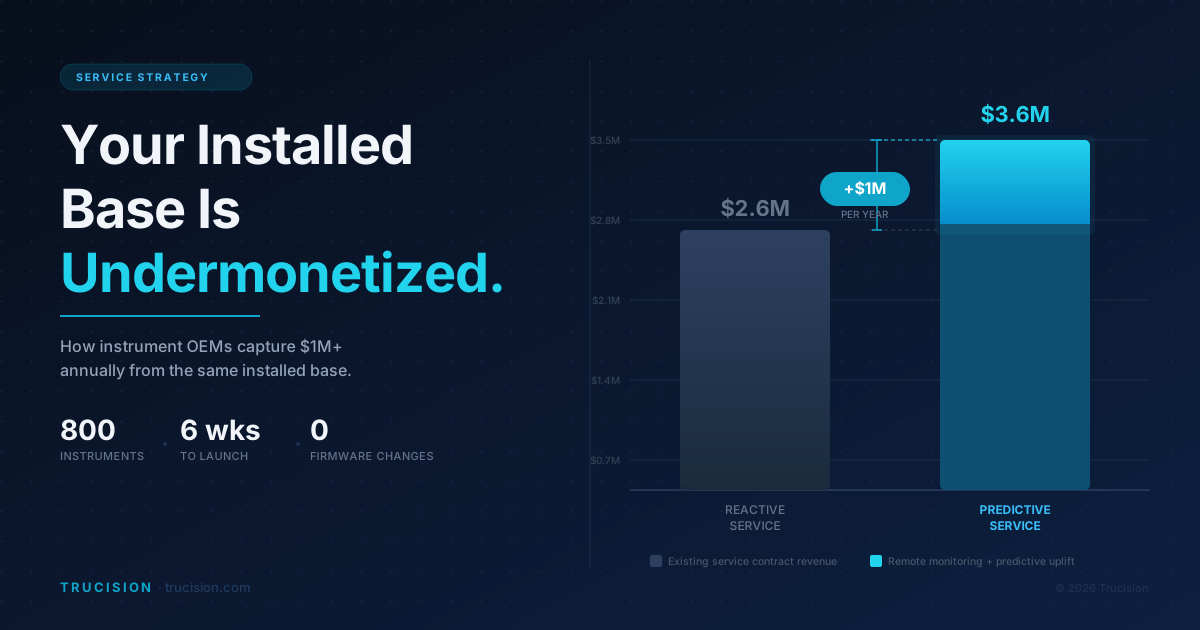
Consider an OEM with 800 instruments deployed across regulated labs in North America and Europe. Average instrument value: $60,000. Average annual service contract (reactive): $4,800 per instrument (8% of instrument value). Of those 800 instruments, 550 are under some form of service contract. 250 are on time-and-materials only.
Current annual service revenue: ~$2.6M
Now layer in a remote monitoring tier adopted by 40% of the contracted base (220 instruments), priced at an additional 4% of instrument value per year:
Remote monitoring add-on revenue: ~$528,000
Add a predictive tier adopted by 20% of the contracted base (110 instruments), priced at 10% of instrument value per year (replacing the base contract):
Predictive tier uplift: ~$330,000 net uplift over base contract pricing
Cost impact: If remote diagnostics resolves 35% of cases that would have required a field dispatch, and the average loaded cost of a field dispatch is $1,200, with 400 dispatches per year: that's 140 avoided dispatches, or $168,000 in avoided cost.
Total annual impact: ~$1M in new revenue and cost avoidance from a standing installed base — no new capital sales required.
Scaled to a larger portfolio, or with higher instrument values (analytical instruments in the $100K–$300K range), the numbers grow proportionally.
This is not hypothetical. It is the model that instrument OEMs across analytical, materials testing, and bioprocess categories are now building — and the ones building it earliest are locking in service revenue before competitors have a product to offer.
The question we hear most from OEM service and product leaders is not whether this model works. It's where to start without disrupting the R&D roadmap or creating a firmware dependency.
The answer is almost always the same: start with one instrument line, in one geography, with one telemetry schema. Get live data flowing. Build the first predictive model against your top three failure modes. Launch a remote monitoring add-on for existing customers on that line. Measure the dispatch reduction and contract uplift over 90 days.
That is a 6-to-8-week pilot with a defined outcome — not a multi-year platform transformation. The installed base, the compliance framework, and the service revenue model scale from there.
If you are responsible for service strategy or product roadmap at a lab instrument OEM and this is a conversation you have been circling, the scoping call takes one session.
[Book a 30-minute scoping call with a Trucision regulated industry specialist →]
Trucision deploys edge-based remote diagnostics and predictive service platforms for lab instrument OEMs in regulated environments. 21 CFR Part 11, ISO 13485, and EU Annex 11 compliant. No firmware rewrite required.


