

There's a moment that happens in every plant, every facility, every fleet. A technician walks past a piece of equipment that's been running fine for months. Hours later, it fails. The post-mortem always reveals the same thing: the warning signs were there in the data — vibration shifting, temperatures creeping, pressure ratios drifting — but nobody was watching the right signals at the right time.
This isn't a staffing problem. It's a signal problem. And it's exactly what Trucision is designed to solve.
Modern industrial equipment generates enormous amounts of sensor data — often hundreds of readings per second, across dozens of channels. Most of it flows into historians or data lakes and stays there. The operations team gets dashboards with threshold alarms. The maintenance team responds when something breaks or when the calendar says it's time.
Neither approach uses what the data is actually telling you.
Trucision closes that gap. It turns continuous sensor streams into a living picture of your equipment's health — not just whether something is wrong right now, but how long you have before it becomes a problem, and what's driving it.
Most anomaly detection tools compare current readings against historical averages or fixed thresholds. They're reactive by design. They tell you something is wrong after it's already wrong.
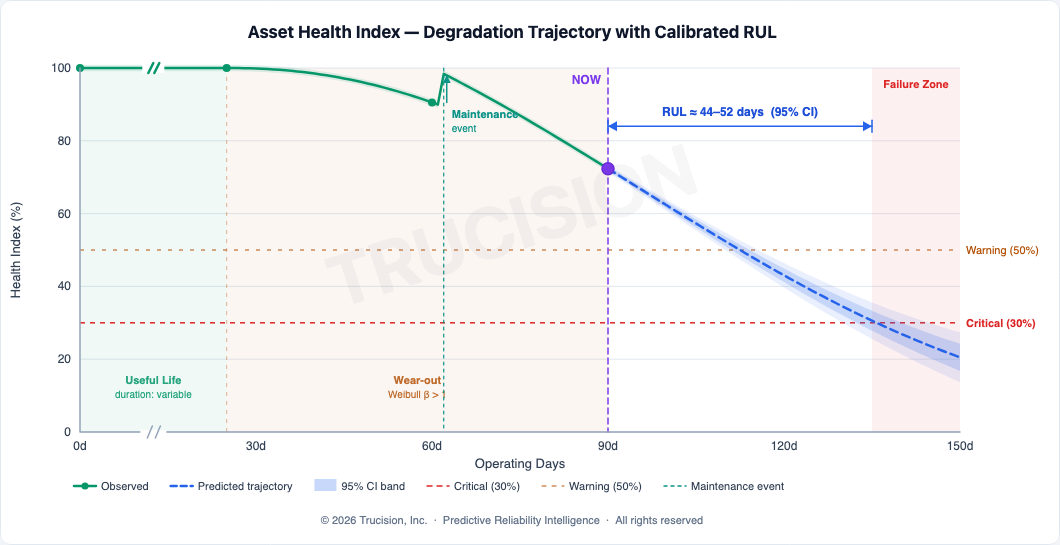
Trucision's health modeling layer learns the *trajectory* of how your specific equipment degrades — not how equipment in general degrades. It understands that a compressor running at 40°C ambient in summer behaves differently than the same compressor in winter. It accounts for load cycles, operating regimes, and the accumulated history of how this particular asset has been run. From that, it builds a continuously updated health index: a single, interpretable signal that tells you where your equipment is in its degradation curve and where it's headed.
Under the hood, this is a multi-model ensemble: physics-informed neural networks enforce monotonic degradation constraints, Weibull survival models calibrate failure timing from fleet-wide history, and Bayesian state-space filters fuse incoming sensor evidence with prior degradation beliefs — updating the RUL (Remaining Useful Life) estimate in real time as new readings arrive. Conformal prediction wrappers produce statistically valid confidence intervals without assuming any distributional form, so when Trucision says "44–52 days remaining," that interval is calibrated against held-out failure events, not theoretical bounds.
We respect the physics of your equipment.
Data-only models can learn patterns that look real but aren't. A purely statistical model might predict that a bearing gets healthier under certain load conditions simply because the training data happened to show that pattern. That's dangerous.
Trucision's core engine is built with the physics of degradation in mind. The health models we deploy embed domain constraints directly into the learning objective: bearing wear accumulates monotonically, fatigue crack growth follows Paris-law kinetics, thermal cycling damage is non-reversible. These constraints aren't hand-coded rules — they're soft constraints in the loss function that let the model fit your specific data while remaining physically plausible. The result is fewer hallucinated "recoveries," more confident predictions at low-data regimes, and maintenance recommendations you can defend to an engineering review board.
We give you time, not just alerts.
The output of Trucision isn't an alarm that says "something is wrong." It's a forecast: *this asset has an estimated X operating hours remaining before maintenance is required.* That forecast comes with a calibrated confidence window, and it updates continuously as new sensor data arrives. You can plan around it.
Every recommendation comes with a reason.
One of the reasons AI hasn't been adopted more broadly in maintenance-critical industries is trust. A system that says "replace this component" but can't explain why gets ignored — or worse, blindly followed. Trucision surfaces the specific sensor patterns and conditions that drove each recommendation, in plain language. Your operators can verify the reasoning. Your engineers can use it to improve equipment design. Your auditors have a record.
Explainability isn't a feature we added at the end. It's an architectural requirement. Attribution scores trace each health index movement back to the sensor channels that moved it, using SHAP-style decompositions adapted for time-series degradation signals, so you know whether the RUL shortening was driven by temperature, vibration, or a shift in operating load.
The Agentic Layer: From Prediction to Autonomous Action
Predicting failure is necessary. Acting on that prediction — across dozens of assets, competing maintenance windows, spare parts availability, and crew schedules — is where most predictive maintenance systems stop.
Trucision doesn't stop there.
The platform's agentic reasoning layer operates continuously across your asset fleet. It doesn't wait for a human to notice that an RUL estimate crossed a threshold. It monitors asset health trajectories, cross-references production schedules and parts inventory, evaluates the cost and risk tradeoffs of deferring versus advancing maintenance, and issues ranked work order recommendations — with full reasoning attached.
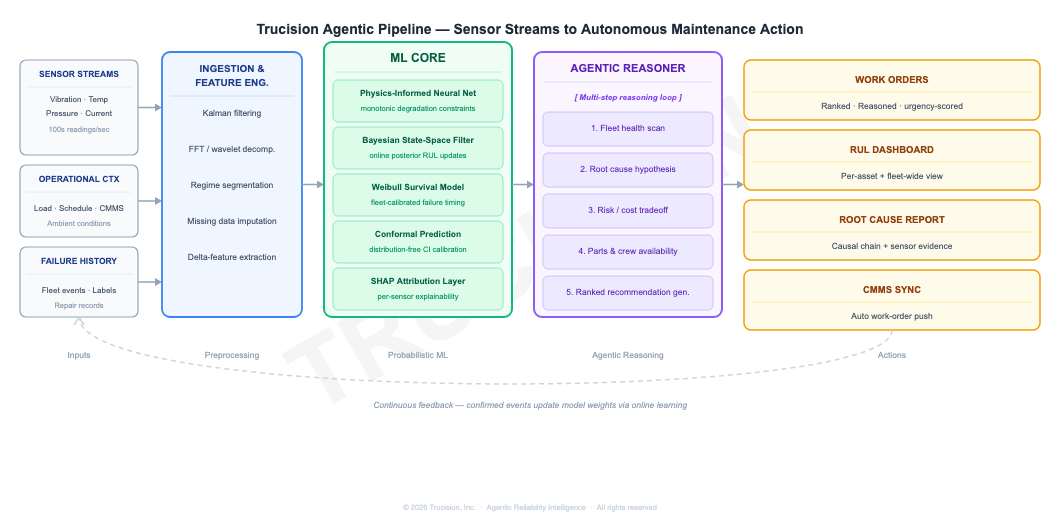
When an asset's health index deteriorates faster than the model expected, the agent doesn't just raise an alert. It re-examines recent operational context — load spikes, ambient conditions, recent repairs — to determine whether the acceleration is anomalous or explained. It queries historical failure records for similar degradation signatures. It estimates the consequence of failure given the asset's current role in the production process. And it generates a structured recommendation with confidence, urgency, and the evidence chain that supports it.
This is what distinguishes a monitoring tool from an intelligent maintenance partner. The agent acts with the reasoning of a seasoned reliability engineer — drawing on the full operational context, not just the sensor reading that crossed a line.
Advanced Reliability Modeling at the Core
For teams with a quantitative background: Trucision's reliability engine is built on the Prognostics and Health Management (PHM) framework, extended with modern probabilistic ML.
Degradation path models fit individual asset trajectories using hierarchical Bayesian priors over fleet-wide degradation parameters, so even assets with limited history benefit from fleet-level inference. The model knows what "typical" degradation looks like for your equipment class and updates toward the individual asset's observed trajectory as data accumulates.
Proportional hazards extensions . allow the baseline failure rate to be modulated by time-varying covariates — operating load, ambient temperature, duty cycle — so RUL estimates respond dynamically to how the equipment is being used right now, not just how it's been used on average.
Multi-failure-mode decomposition separates the competing risks of different failure mechanisms (e.g., fatigue vs. lubrication breakdown vs. electrical insulation degradation) so that the overall health index reflects which failure mode is currently dominant — and the maintenance recommendation targets the right intervention.
Continuous model updating uses online learning to incorporate new labeled failure events (and confirmed non-events) as they occur, closing the feedback loop between prediction and observed outcome. Models don't drift as your equipment ages or as operating conditions shift; they adapt.
The Problems Trucision Solves
Unplanned downtime costs industrial operators an estimated 5–20% of productive capacity per year. Trucision's predictive horizon — updated continuously, specific to each asset — lets you convert emergency repairs into planned maintenance windows. The asset still gets fixed; it just gets fixed on your schedule.
Over-maintenance is the less-discussed twin problem. Fixed-interval schedules cause teams to replace components that have significant life remaining. Trucision shows you the actual condition of each asset, so you replace what needs replacing — not what the calendar says.
Incident investigation is slow, expert-dependent, and inconsistent. When something does go wrong, Trucision's root cause layer structures the investigation automatically, surfacing the most probable causal chains from sensor history and operational context. What used to take days of expert analysis takes minutes.
Knowledge retention is a growing challenge as experienced engineers retire. Trucision captures the implicit diagnostic knowledge that experienced operators use — the pattern recognition that tells them something "sounds wrong" or "doesn't feel right" — and makes it available to the whole team, not just the people who've been doing this for 30 years.
Who It's Built For
Trucision is designed for operations and maintenance leaders in industries where equipment reliability is a competitive and safety-critical concern: energy and utilities, oil and gas, manufacturing, process industries, aviation MRO, and transportation infrastructure.
It doesn't require a data science team to operate. It integrates with the sensor infrastructure and historian systems you already have. And it's built to work alongside your maintenance management system — not replace it.
For organizations that *do* have reliability engineers and data scientists: Trucision exposes the underlying model parameters, calibration diagnostics, and degradation fits — so your technical team can interrogate, validate, and build on the platform's outputs rather than treating them as a black box.
The Bottom Line
Your equipment is already generating the data that could predict its next failure. The question is whether you have a system that can turn that data into a maintenance decision before the failure happens — not after.
Trucision doesn't just predict. It reasons, plans, and recommends — with the rigor of quantitative reliability engineering and the autonomy to act at fleet scale.

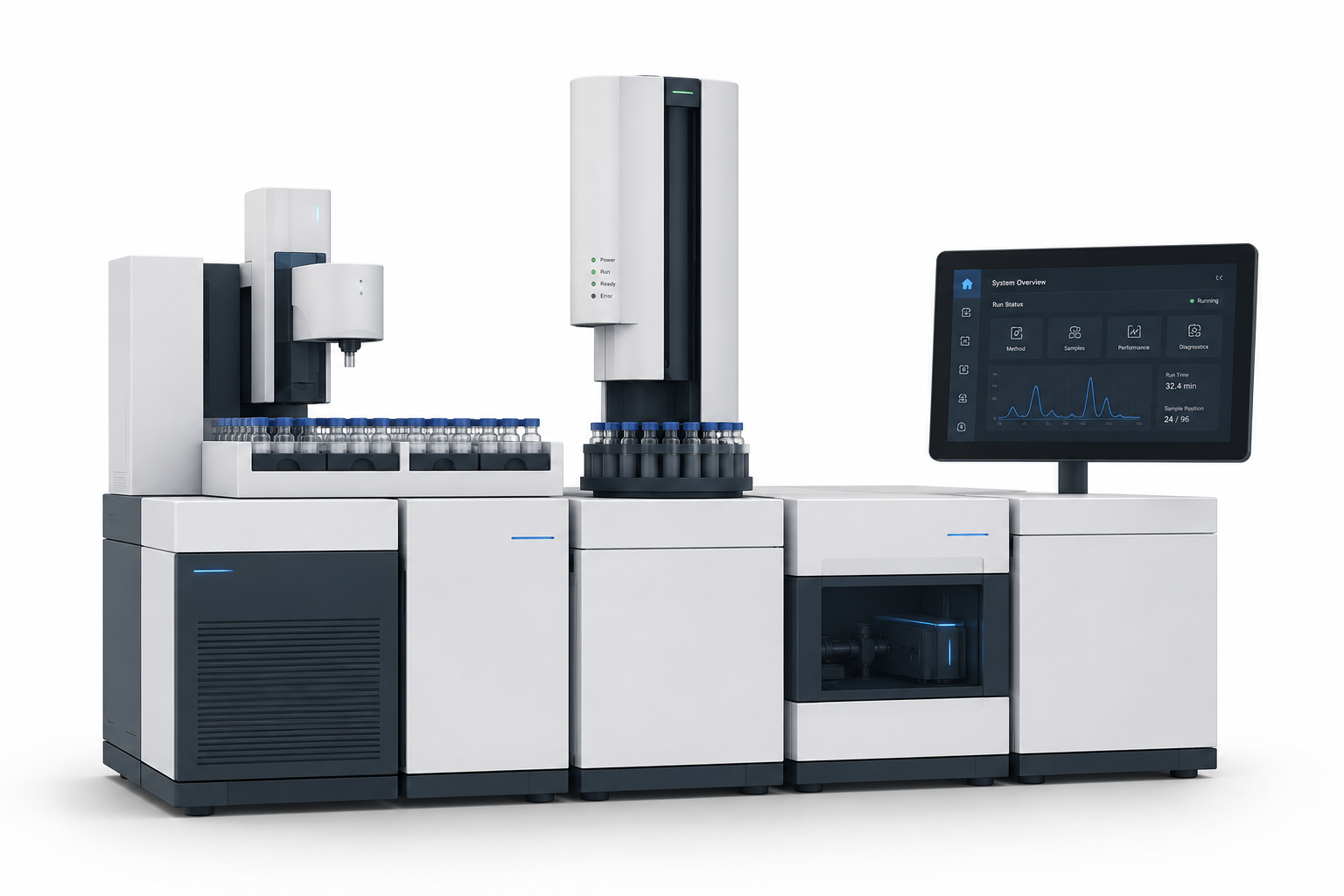
AI driven lap operations for regulated industries.Predictive diagnostics, service monetization, and compliance-grade telemetry for instrument OEMs.
BUILT FOR SECURE OEM DEPLOYMENT